 info@eprobe.tech
 +49(0)361-710-147-80
info@eprobe.tech
+49(0)361-710-147-80
+49(0)361-710-147-80
info@eprobe.tech
+49(0)361-710-147-80

The application of magnetic resonance experiments on functioning batteries is an outstanding approach to research new energy storage materials and optimise existing technologies. The experiments, however, do come with challenges that one can tackle with ePROBE hardware and consultancy. Here, we share some insights to the field.
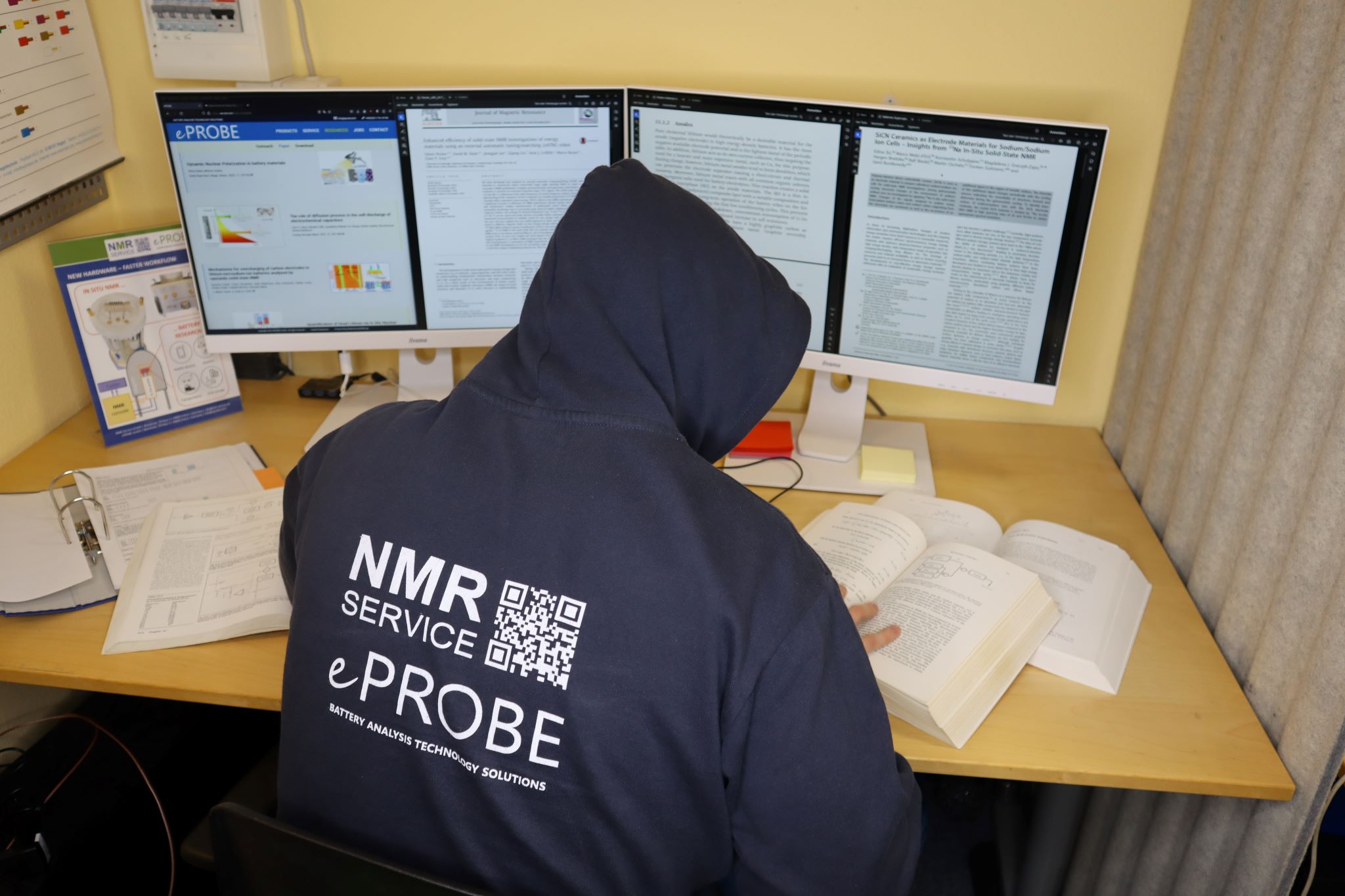
The (extlink: https://www.bam.de/Content/DE/Projekte/Berlin-Battery-Lab-BBL/Berlin-Battery-Lab-BBL.html text: Berlin Battery Lab (BBL)) is a collaborative initiative of BAM, HU Berlin, and HZB to develop innovative and sustainable battery materials. BBL streamlines the knowledge transfer from research results to industrial applications. BBL comes with a state-of-the-art solid-state in situ / operando NMR equipment to investigate energy storage materials while being charged and discharged.
(extlink: https://www.rbb-online.de/abendschau/videos/20260318_1930/Berlin-Batterie_Natrium.html text: RBB news on the BBL opening event on 19 March 2026 and a most recent publication on Core-Shell: battery materials.)
(extlink: https://www.youtube.com/watch?v=-SM0RAPcfXE text: Video-Tutorial © 02/2026 Bruker BioSpin)
Preparing an electrochemical cell correctly is essential for reliable operando NMR experiments. In this video, we walk through the key steps of assembling a stable cell suitable for solid‑state NMR using Bruker's and ePROBE's advanced tools and accessories. Once the setup is complete and charging or discharging begins, the configuration enables real‑time observation of chemical and structural changes in battery materials.
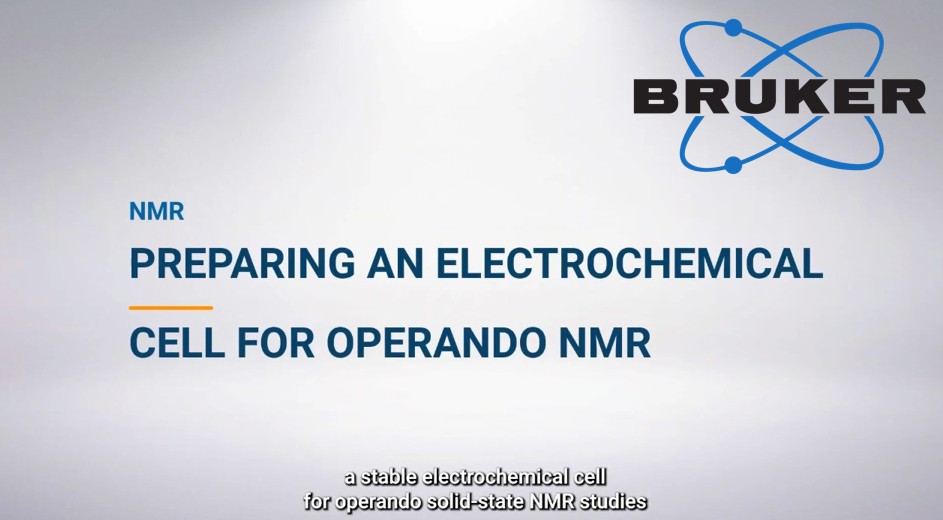
(extlink: https://www.bruker.com/en/resources/library/application-notes-mr/coin-cell-battery.html?scrollToFormContent=embedform-ec8f1cb3a4 text: Bruker Application Note 2026 © 02/2026 Bruker BioSpin)
by Oliver Pecher, Pascal Scholzen (ePROBE) and Sebastian Wegner, Edina Šić (Bruker)
This application note demonstrates how ePROBE’s and Bruker’s advanced NMR probe technology enables direct investigation of fully assembled coin cell batteries under working conditions. The note highlights practical workflows, probe design features, and representative operando data from NMC811/graphite cells assembled using stainless steel coin case. Combining operando solid-state NMR with coin cell formats provides practical, real-time insight into battery materials while accelerating development and improving understanding of performance-relevant processes.
(extlink: https://www.technologynetworks.com/applied-sciences/articles/solid-state-nmr-finds-its-place-in-energy-storage-research-understanding-paramagnetic-materials-408250 text: Technology Networks - Applied Sciences Article, February 2026)
by Edina Šić (Bruker), Juan Miguel López del Amo (CIC energiGUNE), Kent Griffith (University of California, San Diego), Elodie Salager (CNRS, CEMHTI Orléans)
Discover how using NMR spectroscopy at a reduced magnetic field is improving paramagnetic and metallic materials analysis, with the focus on the ex situ and in situ analysis of electrochemical energy storage materials.
(extlink: https://www.batterytechonline.com/battery-manufacturing/how-nmr-spectroscopy-enhances-lithium-ion-battery-innovation text: Battery Technology Article, January 2025)
by Jörg Köhler (Bruker) and Sarah Mailhiot (Bruker)
As electric mobility pushes rapidly toward a zero-emission future, the pressure to develop lithium-ion batteries that are reliable, powerful, and environmentally responsible is stronger than ever. NMR spectroscopy is emerging as a key technology of battery research and production, offering a clearer understanding of material behavior, boosting performance capabilities, and helping manufacturers meet evolving international standards.
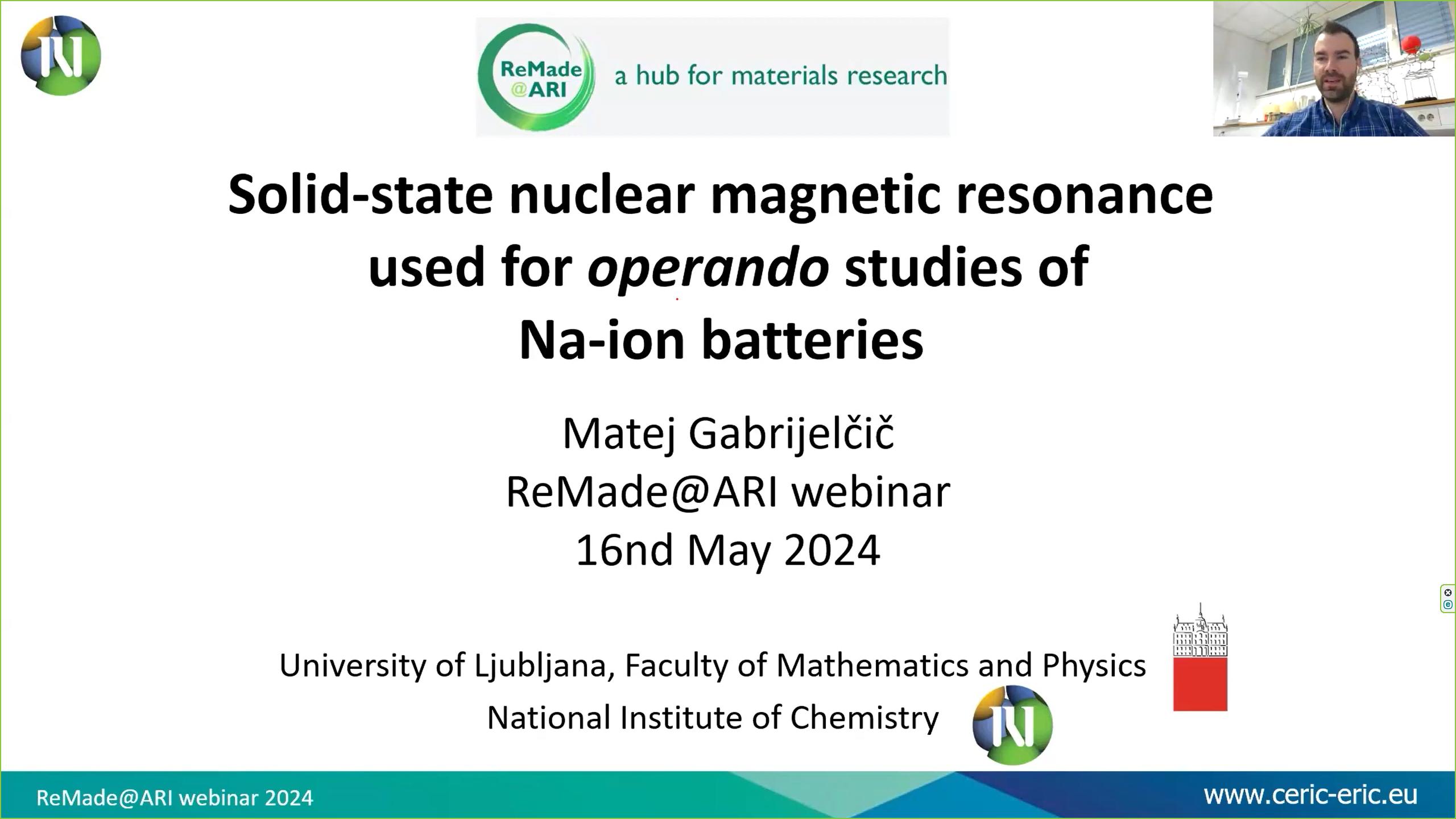
(extlink: https://www.youtube.com/watch?v=6kiw1YS3FW4 text: Webinar: Solid-state nuclear magnetic resonance used for operando studies of Na-ion batteries on 16 May 2024 by Matej Gabrijelčič, National Institute of Chemistry, Slovenia)
Current research efforts in the field of energy storage are focused on finding alternatives to lithium-ion batteries (LIBs). Among these are sodium-ion batteries (SIBs) due to the high availability of sodium, its low cost, and suitable redox potential. Hard carbons, which are suitable for anodes in SIBs, exhibits good electrochemical performance and cyclic stability. However, the exact mechanism of their operation remains unknown. In this study, the physical and electrochemical properties of corncob derived hard carbon prepared at 1400 °C were established via solid-state ex-situ and operando NMR spectroscopy.
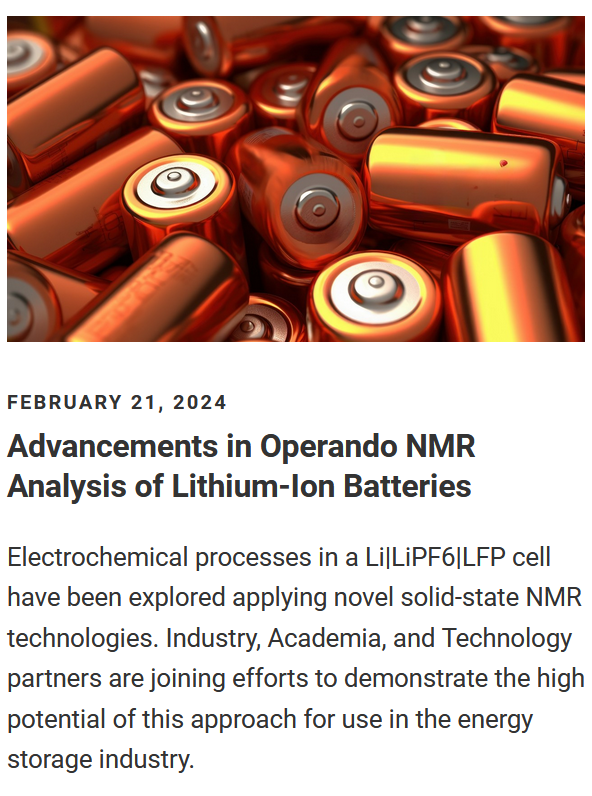
(extlink: https://www.bruker.com/en/news-and-events/webinars/2024/advancements-in-operando-nmr-analysis-of-lithium-ion-batteries.html text: Webinar: Advancements in Operando NMR Analysis of Lithium-Ion Batteries on Wednesday, 21 February 2024, 5 PM CET.) Electrochemical processes in a Li|LiPF6|LFP cell have been explored applying novel solid-state NMR technologies. Industry, Academia, and Technology partners are joining efforts to demonstrate the high potential of this approach for use in the energy storage industry. Join Dragonfly Energy, Darmstadt Technical University, ePROBE and BRUKER BioSpin as they discuss about an experimental procedure for routine application of in-situ Solid-State NMR for battery research.
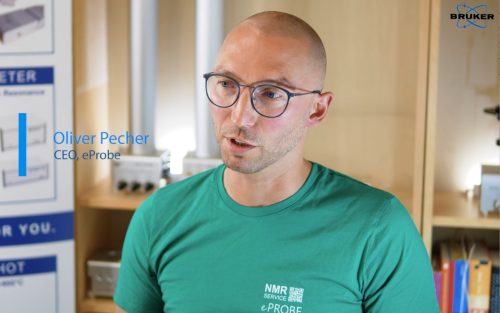
(extlink: https://www.bruker.com/en/landingpages/bbio/oliver-pecher-interview.html text: Video Interview with Oliver Pecher (ePROBE)) on hardware solutions and approaches in magnetic resonance to research energy storage materials, © 12/2023 Bruker BioSpin. Further information to be found on Bruker's (extlink: https://www.bruker.com/en/products-and-solutions/mr/nmr-epr-battery-research.html text: speciality probes) and (extlink: https://www.bruker.com/en/products-and-solutions/mr/nmr/solid-state-nmr/specialty-solids-probes.html text: battery landing webpage).
(extlink: https://www.bruker.com/en/landingpages/bbio/mr-for-battery-research/battery-research-probes-li-ion-technologies.html text: Bruker Application Note 2023), Order No. T194448 © 09/2023 Bruker BioSpin
by Oliver Pecher (ePROBE) and Sebastian Wegner (Bruker)
Bruker's specialized solid-state NMR probes and in situ NMR accessories provide a powerful tool for optimizing battery performance. By operating in situ, analytical solutions for the characterization of batteries can accurately detect critical quality attributes and measure processes occurring during charge and discharge cycles. With Bruker's cutting-edge RF generation console AVANCE NEO and ePROBE's technologies, researchers can gather meaningful insights and benefit from optimized R&D as well as rapid and accurate quality inspection activities.
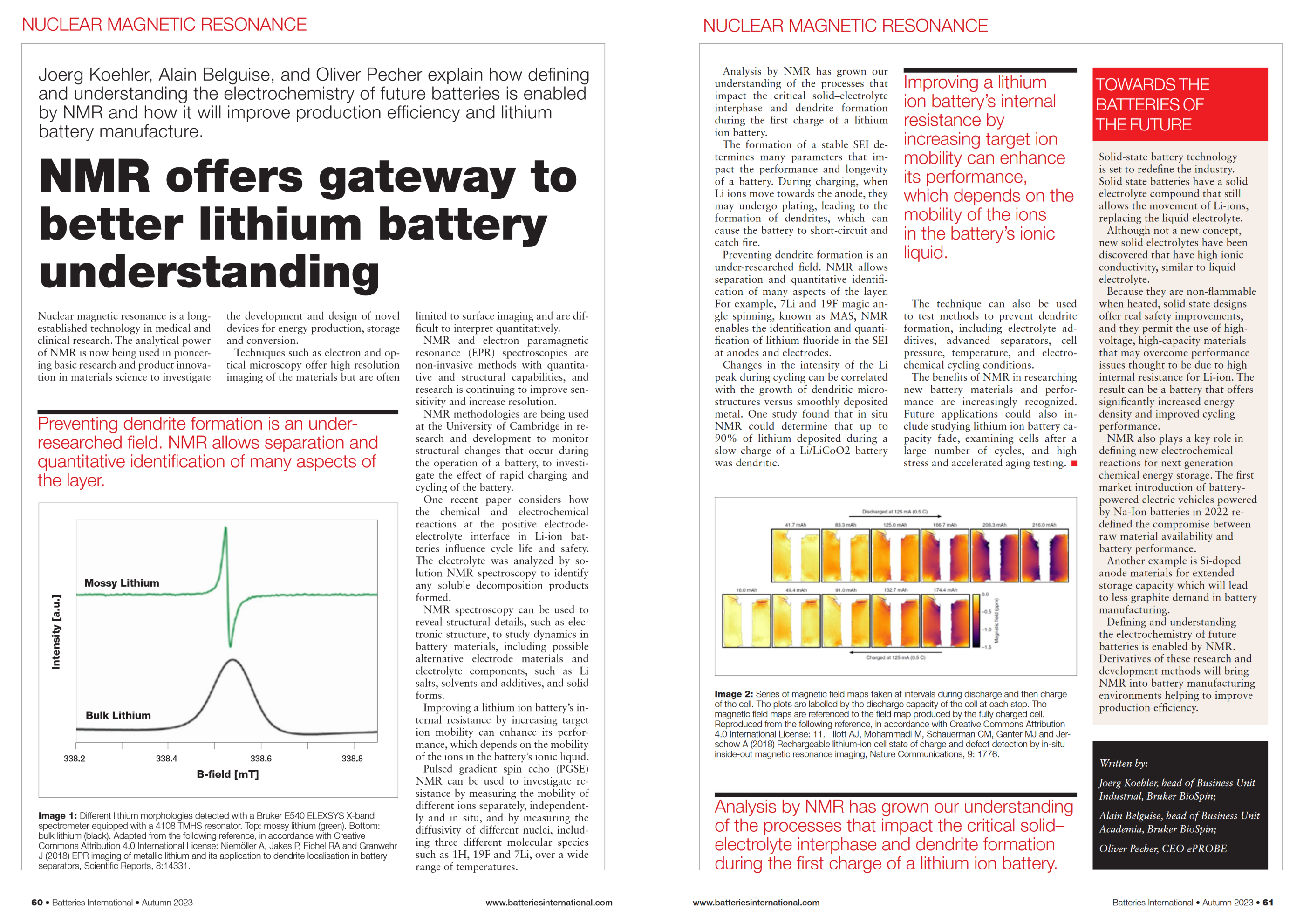
(extlink: https://issuu.com/rizzo48/docs/batteriesinternationalautumn2023issuu text: Batteries International Article, Autumn 2023)
by Jörg Köhler (Bruker), Alain Belguise (Bruker), and Oliver Pecher (ePROBE)
We explain how defining and understanding the electrochemistry of future batteries is enables by NMR and how it will improve production efficiency and lithium battery manufacture.
Watch this space for your customised solution - contact us.